
Weekly Pool Service in North Texas
Southern Pool + Outdoors handles weekly pool service across North Texas. Every visit, we test and balance the water, clean the pool and check the equipment, then send you a report. Call (214) 922-1914.

Want a pool you never have to think about? Get a free weekly pool service quote from Southern Pool + Outdoors.
Schedule Service!
Balanced Water, Not Just Clear Water
A pool can look perfect and still be eating itself. Water that runs low on pH or calcium pulls minerals out of plaster and tile grout, and it corrodes the copper and iron inside pumps, heaters and valves. Push the water too far the other way and it drops calcium carbonate as scale, a rough gray crust on the tile line, in the filter and on the heater. Both problems build slowly, so the pool keeps looking fine right up until the damage shows.
That is why our weekly pool service balances water with the Langelier Saturation Index (LSI), not just a chlorine reading. The LSI rolls pH, alkalinity, calcium hardness, temperature and dissolved solids into one number. Anything between -0.3 and +0.3 is balanced, and that is the window we work to every week. Below that range the water turns corrosive, and above it the water starts scaling. Summer makes this harder here, because warm water holds less calcium.
An honest LSI takes more than a test strip. Stabilizer inflates the alkalinity reading, so we subtract one third of the CYA level from total alkalinity before running the number. Dissolved solids count too. Every chlorine dose and every inch of evaporation leaves salts behind, and once TDS climbs about 1,500 ppm above where the pool started, the water looks dull and tired even when it tests clear.
Keeping the LSI in range helps prevent:
- Scale on tile and equipment
- Cloudy water from calcium dropping out
- Corrosion of pump, heater and plumbing metals
- Etched or rough plaster
- Copper and iron stains
- Wasted chemicals and early equipment wear
Our goal is to maintain water that is: Balanced. Comfortable. Protective.
MORE THAN POOL SERVICE
Southern Pool + Outdoors builds our service around a simple promise:
Clear Waters. Reliable Service. Honest Communication. Every Visit.
At Southern Pool + Outdoors, we provide dependable Weekly Pool Service in North Texas designed to take the management and guesswork out of maintaining your swimming pool leaving you able to enjoy your backyard retreat. Our goal is to keep your water clean, properly balanced, and ready to enjoy while ensuring your pool equipment operates at its best.
Every week we ….
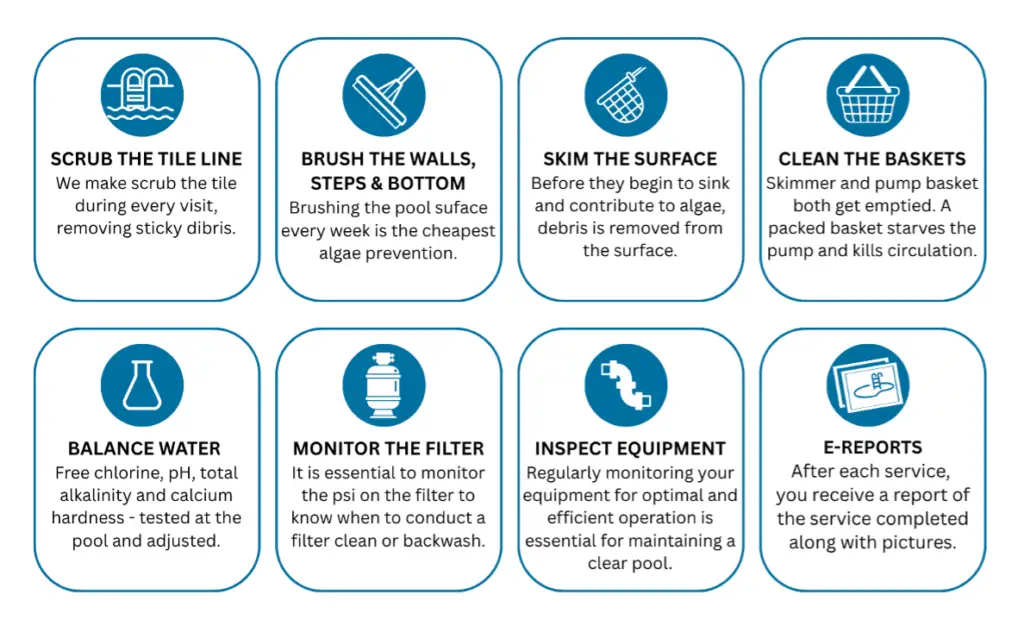
In addition to Weekly Pool Service, Southern Pool + Outdoors provides services such as Pool Filter Cleaning, Pool Tile Cleaning, Pool Repairs, Equipment Installation, and Green Pool Cleaning to help keep your entire pool system in better condition.
We Are Experts With:




Why North Texas Pools Need Weekly Pool Service
North Texas is hard on pool water. Summer heat, hard fill water, spring pollen and sudden storms all push chemistry out of range, and none of them wait for a convenient week. A week is about as long as a pool here can go before small drift shows up as cloudy water, algae or scale.
Heat and Sun Burn Through Chlorine
Sunlight destroys unprotected chlorine fast. In an outdoor pool with no stabilizer, half the free chlorine can be gone in less than an hour of direct sun. Cyanuric acid (CYA), sold as stabilizer or conditioner, shields chlorine from UV so it lasts three to ten times longer. The target is 30 to 50 ppm.
More is not better, though. CYA doesn’t sanitize anything on its own, and high levels go hand in hand with more algae trouble. It also doesn’t burn off the way chlorine does. Once it’s in the water, the only practical way to lower it is to drain part of the pool and refill. Chlorine tablets (trichlor) add CYA every time one dissolves, so a pool fed tablets all summer can end up well over 100 ppm. We test CYA at every visit, which catches the climb long before it turns into a drain-and-refill job.
Heat pushes water toward scale too. Calcium gets less soluble as water warms, so water that was balanced in April can start scaling by August. That is the main reason we recalculate the LSI every week instead of trusting last month’s numbers.
Hard Water and Calcium Scale
Hard water is common across North Texas, and summer evaporation makes it worse. When pool water evaporates, only pure water leaves. Calcium and other dissolved solids stay behind, and the fill water that replaces the loss brings in more. Over a season, the buildup shows up as white or gray crust at the tile line, scale inside the heater and a filter that clogs faster.
For a plaster pool, the ideal calcium hardness is 200 to 400 ppm. Once calcium climbs past about 500 ppm, you have to hold pH and alkalinity lower than normal to keep scale from forming. Near 1,000 ppm, keeping the water balanced becomes close to impossible. Lowering calcium means draining and refilling, and that costs real money. We’d much rather manage the LSI every week than chase scale after it hardens.
Spring Pollen and Fall Leaves
Spring coats North Texas pools in yellow oak pollen, cottonwood fluff follows, and fall drops leaves from live oaks and cedar elms. Strong south winds carry dust and grass clippings in all year. Every bit of it feeds the problem. Decaying leaves, lawn fertilizer and bird droppings carry phosphates and nitrates, which are plant food for algae. Organic debris also uses up chlorine that should be sanitizing the water.
Algae always has something to eat in a backyard pool. What keeps it out is steady chlorine plus regular brushing, so skimming, brushing and basket cleaning happen at every visit.
Spring Storms and Winter Freezes
A spring storm can dump inches of rain in an afternoon. Rain dilutes chlorine, knocks pH around and washes yard debris and fertilizer into the pool. So the visit after a big storm usually means more chlorine and a pH correction. Heavy rain can also raise the water above the skimmer opening, which stops surface skimming until the level comes down.
Winter is not a break from pool care here. North Texas sees freezing nights most winters, and the February 2021 storm showed what happens to equipment that freezes with water sitting in it. Moving water resists freezing, so a running pump or working freeze protection matters. Cold water also leans corrosive, so balance still needs checking even when nobody is swimming.
What's Included in Every Weekly Pool Service Visit
Here is what a full-service weekly visit from Southern Pool + Outdoors covers. Every pool is different, so we adjust the routine to your equipment, your finish and how often the pool gets used.
Water Testing and Chemical Balancing
Every visit starts with a full water test. We check:
- Free and combined chlorine
- pH
- Total alkalinity
- Stabilizer (CYA)
- Calcium hardness
- Salt level on salt pools
Then we adjust in the right order. Alkalinity comes first because it anchors pH, pH comes second, and calcium comes third. Skip that order and pH tends to bounce all week. We aim for pH between 7.4 and 7.6, close to the pH of your eyes, so the water feels comfortable and chlorine works at full strength. At a pH of 7.8, a smaller share of your chlorine is in its active form, so the same reading does less work.
Free chlorine stays in the 2 to 4 ppm range most of the time. The CDC recommends at least 2 ppm for any pool that uses stabilizer, per its home pool water testing guidance. We also check combined chlorine, which forms when chlorine reacts with sweat and other nitrogen waste. Combined chlorine is the part that causes the “chlorine smell” and red eyes, and it does very little sanitizing.
Skimming, Brushing and Vacuuming
We skim the surface, brush the walls, steps and tile line, and vacuum the floor. Brushing is the step most people skip when they handle the pool themselves, and it matters more than it looks. Bacteria protect themselves by forming biofilm, a slime layer on pool surfaces. Bacteria inside biofilm can take a disinfectant level 100 times higher to kill than bacteria floating in the water. Brushing breaks that layer up and pushes the debris into circulation, where the filter can catch it.
Brushing the tile line also stops a scum line from forming where body oils, sunscreen and dust collect. Calcium that has already hardened on the tile needs more than a brush, and that is what our tile cleaning service is for.
Pump Baskets and Filter Pressure
Full skimmer and pump baskets starve the pump of water. The pump works harder, moves less water and, in bad cases, cavitates, which sounds like gravel rattling through the housing. We empty both baskets every visit.
We also read the filter pressure gauge. For sand and DE filters, we backwash when pressure climbs 8 to 10 psi above the clean starting pressure. The gauge decides, not the calendar. Backwashing too often wastes water and can leave the water less clear, because a slightly dirty sand bed actually filters finer. Our Full Service plan also includes filter cleanings twice a year, and the filter cleaning page covers how we handle them.
Filtration only works when water moves. One full turnover pushes about 63% of the pool’s water through the filter, and it takes roughly four turnovers to filter all but 2%. So pump run time matters as much as the filter does, which is why we check the timer settings at every visit.
Equipment Checks
While we’re at the equipment pad, we look over the pump, filter, heater, salt system, timers and automation controls. We watch for pressure changes, leaks, noisy motors, error codes and parts that are starting to fail. A weeping pump seal caught in May costs far less than a pump that runs dry in July. When something needs work, our pool repairs team takes it from there.
Salt pools get extra attention. A salt chlorine generator makes chlorine from dissolved salt, and the same reaction produces sodium hydroxide, so pH on a salt pool tends to creep up week after week. Hard North Texas water adds another problem: calcium scale builds on the cell plates and cuts chlorine output. We check salt level, pH drift and the cell on every visit, and salt cell cleaning is available as an add-on.
A Service Report After Every Visit
After each visit, you get a digital service report. It shows when we were there, what we cleaned, your chemical readings and what we added, plus anything we noticed that needs attention. You always know the condition of your pool, and you never have to wonder whether the tech showed up.
Weekly Pool Service Plans and Cost in North Texas
Some owners want everything handled, and others only want help with the chemistry. We set up weekly pool service either way.
Chemical-Only or Full Service
We offer chemical-only plans and full-service plans. Chemical-only service covers testing and balancing. It suits owners who already skim, brush and run a robot cleaner but don’t want to manage the chemistry. Full service adds skimming, brushing, vacuuming, basket and filter care, equipment inspections and filter cleanings twice a year. Add-ons include spa cleaning, salt cell cleaning and deep filter cleans. We also set up service for rental homes and pools that only see seasonal use.
What Weekly Pool Service Costs
Weekly pool service from Southern Pool + Outdoors starts at $179 a month. Your price depends on the size of the pool, any attached spa and your equipment. Tree cover over the water and the condition of the pool when we start matter too. A pool that starts out green needs a green to clean recovery first, since weekly care can’t keep up with an active algae bloom. We quote every pool individually, and there is no long-term contract.
Why North Texas Homeowners Choose Southern Pool + Outdoors
You get the same route technician every week, someone who knows your pool and your preferences. There’s no long-term contract. You don’t need to be home, as long as we can reach the pool and the equipment. And after every visit you get a report instead of a guess.
Plenty of homeowners start with DIY pool care and find out how technical it gets in North Texas heat, where one missed week in July can turn the water green. If you’d rather have the pool handled, call (214) 922-1914 or request a quote to set up weekly pool service.
Our Service Areas
- Allen
- Plano
- Dallas
- Mckinney
- Wylie
- Anna
- Fairview
- Prosper
- Lucas
- Celina
- Carlton
- Melissa
Weekly Pool Service Questions From North Texas Homeowners
Here are straight answers to the weekly pool service questions homeowners around North Texas ask most often.
For most North Texas pools, yes. Summer sun can burn off half of unprotected chlorine in under an hour, and hard water starts scaling once balance slips. A weekly visit keeps chlorine, pH and calcium in range before a small drift turns into algae, scale or equipment damage that costs far more to fix.
Weekly pool service from Southern Pool + Outdoors starts at $179 a month. The final price depends on pool size, any attached spa, your equipment, tree cover and the condition of the pool when we start. We quote each pool individually, and there's no long-term contract, so you can judge the work week by week.
Once a week is the standard for a North Texas pool. That's often enough to keep chlorine, pH and stabilizer in range through summer heat, and to empty baskets and brush before algae gets a foothold. Pools under heavy tree cover or with lots of swimmers can need extra attention between visits in peak summer.
A full-service visit covers water testing and balancing, skimming, brushing the walls and tile line, and vacuuming. We also empty the skimmer and pump baskets, backwash by filter pressure, and inspect the pump, heater, salt system and timers. You get a digital report after every visit with your readings and anything that needs attention.
Not automatically. Shock treats combined chlorine, the used-up chlorine that causes odor and red eyes. We test for it at every visit by comparing total and free chlorine. When combined chlorine shows up, we raise free chlorine to about ten times that reading to burn it off. Otherwise, steady chlorine does the job.
Chlorine tablets are the usual cause. Trichlor tablets and dichlor shock add stabilizer every time they dissolve, and CYA doesn't burn off the way chlorine does. Once it's high, the only practical fix is draining part of the pool and refilling. We test CYA at every visit and aim to hold it at 30 to 50 ppm.
It can when stabilizer is in range. With CYA at 30 to 50 ppm, chlorine lasts three to ten times longer in sunlight than unprotected chlorine, which can lose half its strength in under an hour. Heavy swimming, storms and leaves still use chlorine faster. A salt system or chlorine feeder keeps levels steadier between visits.
A full-service visit should include brushing. Brushing breaks up biofilm, a slime layer where bacteria can take 100 times more disinfectant to kill. It also keeps algae and scum lines from settling into corners, steps and tile. Our full-service visits brush the walls, steps and tile line every week.
Look at the service report. After every visit, Southern Pool + Outdoors sends a digital report. It shows when the tech was there, what got cleaned, your chemical readings, what we added and anything that needs attention. If a reading looks off, you see it the same day instead of finding out when the water turns.
A robot cleans the floor, not the chemistry. It won't test pH, track stabilizer or catch scale forming in August heat. If you already run a robot and skim the surface yourself, our chemical-only weekly plan may be all you need. Pools without a robot usually do better with full service.
Still have questions?